
The Real Reason Messaging Feels So Hard to Nail Down (Mind Behind the Marketing – Part 2)
This is Part 2 of a series on what's actually behind the challenge of keeping your marketing going when life and work get relentless. We're not talking strategies or tools here. We're exploring the identity, the mental friction, and the foundational practices that make consistent marketing possible.
If marketing is, at its core, about building relationships—meeting people, having real conversations, following up, asking for the business—then you need some basics in place to do that well.
A nice website or a polished LinkedIn profile can be helpful. But they aren’t necessary because you can land clients without them.
You can’t win business without words.
Words that win clearly explain what you do, who you do it for, and why you’re the best option for your ideal clients.
You need these words everywhere you show up—online and in real life—to connect, nurture, and convert your ideal clients.
They’re the words you use on your website, your emails, your proposals, etc.
They’re the words you say when someone at a networking event asks what you do or you’re on a discovery call and the person asks, “so tell me more about how this works.“
Your business literally runs on these words.
Figuring out which words to use is the function of messaging and copywriting.
Many people find this work genuinely hard, even trained copywriters and messaging pros working on their own stuff, myself included.
But the part people find hardest isn't what they think it is.
Most assume the challenge is creative, that they need to figure out how to write the best intro, the cleverest framing, the most scroll-stopping headline.
In my experience guiding many dozens of clients through the messaging process, that's rarely where the process breaks down.
Wordsmithing is not the issue.
Decision-making is.
The messaging process generates a lot of information. You're excavating your thinking about your work, your clients, your own history of doing this. You end up with more ideas and options than you can hold in your head at once.
The real task is to wade through all of that and narrow down to something specific, clear, and useful in a reasonable amount of time.
This narrowing is a decision-making exercise about your own business identity, and it’s where most people stall out.
I see people stay in the messaging process for months, sometimes years, convinced that more research, more client conversations, more iterations of their website copy will eventually deliver the certainty they're looking for.
It won't.
There's no magical point in time at which you'll be so thoroughly enlightened about your market that you'll know exactly what to say to make every sale.
What you have to do, which is the harder thing, is make good-enough decisions with the information you have right now.
You decide, for now:
who your ideal client is
how you help them
what they need to understand about you in order to see you as the obvious solution
You don't need perfect answers. You need quick, workable ones.
Will you know more next month, and far more in two years, so that your messaging can get sharper? Yes, almost certainly.
But waiting for that future knowledge kills your momentum and your pipeline in the meantime.
While you're waiting/researching/tinkering, other people are out there having the conversations and landing the clients you want.
The only way to get to the clarity and confidence you want with your messaging is to put your current best version into the world so you can have the conversations and see what lands and what doesn't.
Let reality be your research.
Decisions made in a timely, efficient manner create momentum. Momentum is what gets you to clarity—not the other way around.
As author James Clear explains, “The problem with keeping your options open is that every option requires energy to hold. And a shelf full of maybes is often heavier than a hand holding one yes. Put something down.”
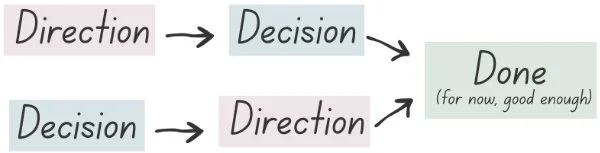
(To get "done" sometimes you have to point yourself in a direction so you can make decisions. Other times you have to make a decision on a direction in order to move toward done. Done is defined as "for now" or "good enough.")
Make decision-making easier and faster with outside eyes
Figuring out what you need to say and writing great copy is nearly impossible to do for yourself, even when you’re a trained messaging specialist or copywriter. You’re inside your jar so can’t possible reaf the label. You need someone with emotional distance and trained perspective to help you sort the signal from the noise.
Good messaging pros know where the common sticking points are and how to move you through them efficiently. My work in Core Copy, specifically, is designed to compress the time between "I don't know what to say" and having the language you need to start real conversations with your next clients. A few hours in a structured environment beats months of second-guessing alone.
Using AI can be helpful. But a generic chat with ChatGPT or Claude, with no training in messaging or conversion strategy, will give you possibilities, not answers. It can generate options, but it can't tell you which of those options will build trust with your specific audience and which will quietly erode it. You need a human expert for that discernment.
One more thing worth naming before we move on.
Messaging work has a way of shaking loose your Inner Critic and the Imposter Monster. I haven't met a single person in my career thus far who is immune to their shouting and insidious whispers.
What will people think?
What will people say to my face or whisper to their buddy or comment in the public feed?
Who do you think you are to say this?
Who do you think you are to own this?
You do not have enough experience / knowledge / practice / money / access / recognition / etc.
I’m not enough.
These are not signs you're doing it wrong. They're predictable responses to doing something new, differently, or with greater exposure than you’re comfortable with.
We'll spend more time on the monsters in a later piece. For now, the important thing to know is that if you're hearing them, it's because you're in the process of something real.
The answer isn't to wait until they quiet down. It's to make your decisions so you can move forward anyway.
The words you're looking for are closer than you think. The thing standing between you and them usually isn't better writing. It’s faster decision-making.
Missed the start of this series?
Read Part 1: What It Takes to Market No Matter What
When you want a clearer picture of where your marketing is breaking down and what to address first, that’s exactly what a Clarity Call is for. Book yours here.